


Modern laptops and fast chargers operate at voltages of up to 20V. A standard 12V vehicle electrical system cannot supply this voltage directly.
Standard USB sockets do supply 5V or 9V – but this is not enough for high-power devices. The result in a campervan: an inverter, a power supply unit, and additional losses.
The convertiger 100 solves this problem directly within the DC circuit: the integrated buck-boost converter boosts the on-board voltage from 12V up to 20V as required.
What this means for you:
Direct charging of 100W USB-C laptops in the camper
Higher efficiency (no conversion losses) than when using an inverter
No standby power consumption from the inverter
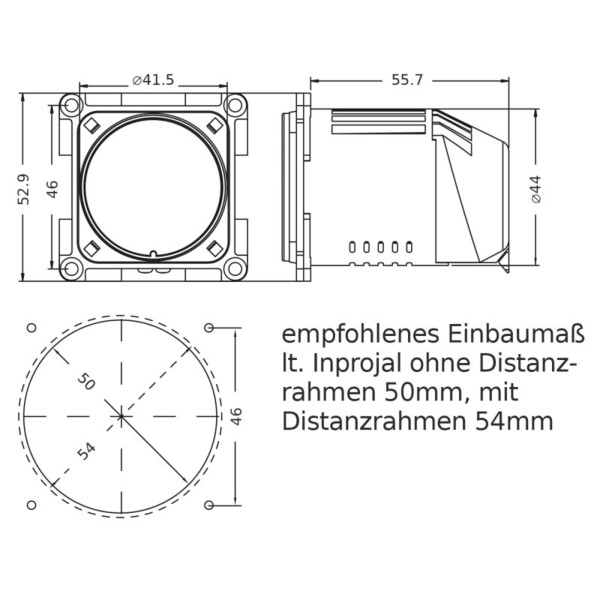
Less installation effort in the vehicle
No distracting light in the camper
The charging voltage is displayed for 20 seconds after plugging in. The display then switches off automatically, with the backlight following after a further 10 seconds.
No distracting light whilst sleeping – no unnecessary energy consumption.
Integration into existing vehicle systems
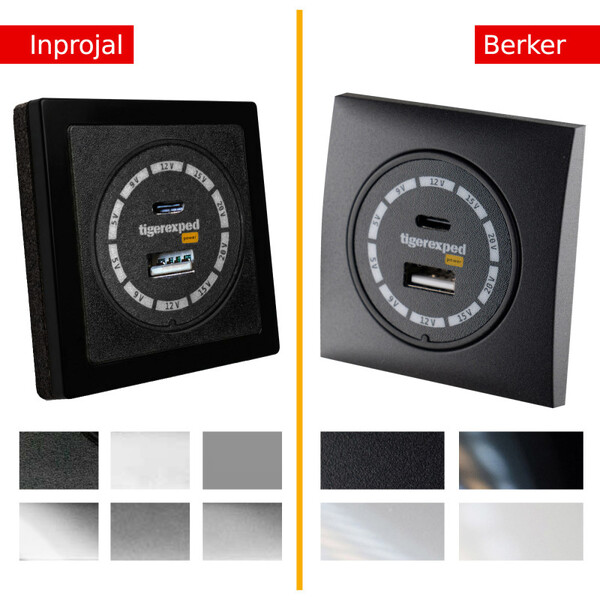
The convertiger 100 fits into:
Inprojal 20000
These switch ranges are used by many major motorhome manufacturers and are widely used in professional van conversions. The socket integrates seamlessly – even in retrofit applications.
Tip: With our switch range configurator, you can put together complete socket and switch combinations for your conversion.
Technical data
- Input: 12 V/24 V DC (10–30 V)
Output:
- USB-A: 5 V / 3 A; 9 V / 3 A; 12 V / 3 A
- (36 W max, at Vin > 13.8 V)
- Charging protocols: QC 3.0
- USB-C: 5 V / 5 A; 9 V / 5 A; 12 V / 5 A;
- 15 V / 5 A; 20 V / 5 A
- (100 W max, at Vin > 11.8 V)
- Charging protocols: PD3.0, QC2.0 + 3.0, PPS: 5–20 V
- Charging both ports simultaneously: USB-C max. 65 W, USB-A max 36 W (at Vin > 13.8 V)
- Standby: < 5mA
- Protection: Overload, overvoltage, short circuit, reverse polarity
- Certification: ECE R10, CE, RoHS, EMC
Cable cross-section recommendations (total length positive + negative)
Cable length 12V system 24V system
- 4m 2.5 mm² 1.5 mm²
- 7m 4 mm² 2.5 mm²
Good to know:
These factors may be responsible for reduced charging power:
- the connected device does not have the appropriate power requirements
- the device’s charge level
- USB-C cable quality (E-mark required for 5A)
- input voltage too low
- ambient temperature too high
Cable recommendation
For full charging power, use a USB-C to USB-C cable that meets the following criteria:
USB-PD certified with a 5 A / 100 W current rating
as short as possible (ideally under 1 m) and sufficiently thick — cables that are too long or too thin cause voltage loss and may interfere with power negotiation
Compatibility issues may arise with the following cable types due to highly inconsistent implementations across the market:
magnetic charging adapters and proprietary charging cables (e.g. Apple MagSafe) — in these cases, not all USB-C pins are magnetically connected; the negotiation is emulated by electronics within the cable and may therefore deviate from the USB-PD specification
Charging cables with an integrated voltage trigger (e.g. in some Starlink configurations), which supply a fixed 20 V to the device instead of negotiating the voltage as normal
Such cables may work, but are not guaranteed to do so. If you encounter problems, please try a standard USB-C cable first.